
Herramienta profesional
todo en uno de detección de paquetes

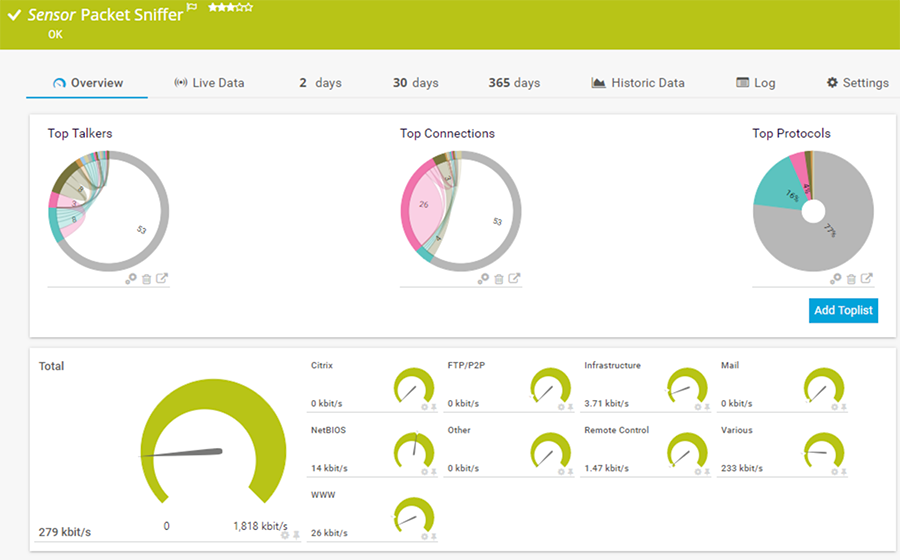
PRTG supervisa el tráfico y los paquetes de datos
PRTG filtra por dirección IP
PRTG filtra por protocolo
PRTG filtra por tipo de datos
Detección de paquetes
con PRTG
PRTG es una herramienta de supervisión de red para Windows que ofrece una serie de posibilidades para la supervisión del ancho de banda y el tráfico. Al supervisar los paquetes de datos, PRTG utiliza SNMP, NetFlow, WMI y la detección de paquetes. El sensor Analizador de paquetes supervisa, entre otras cosas:
-
El tráfico total
-
El tráfico web (HTTP, HTTPS)
-
El tráfico de correo (IMAP, POP3, SMTP)
-
File transfer traffic (FTP, P2P)
-
La infraestructura del tráfico (DHCP, DNS, ICMP, SNMP)
-
El control remoto (RDP, SSH, VNC)
-
Otro tráfico UDP y TCP
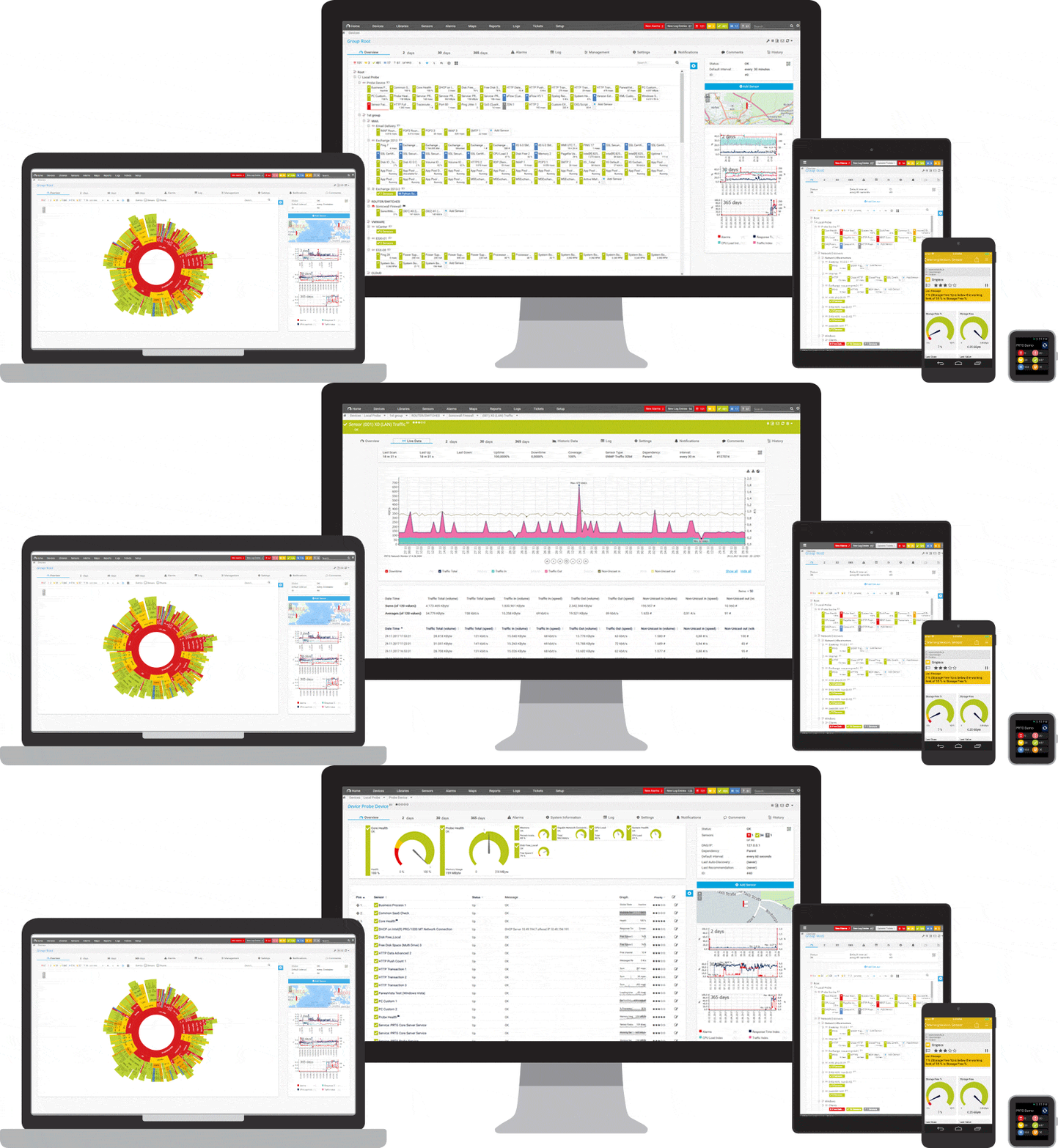
Equipos de escritorio, teléfonos inteligentes, tabletas... puede utilizar PRTG en todos los dispositivos. Y eso significa que siempre sabrá si todo está bien en su red.
 El ancho de banda se mide como la cantidad de datos que se pueden transferir entre dos puntos de una red en un tiempo específico. Normalmente, el ancho de banda se mide en bits por segundo (bps) y se expresa como una tasa de bits. El ancho de banda denota la capacidad de transmisión de una conexión y es un factor importante a la hora de determinar la calidad y la velocidad de una red.
Más informatión
Captura de red: por qué PRTG es la herramienta adecuada para usted

Un resumen constante y completo
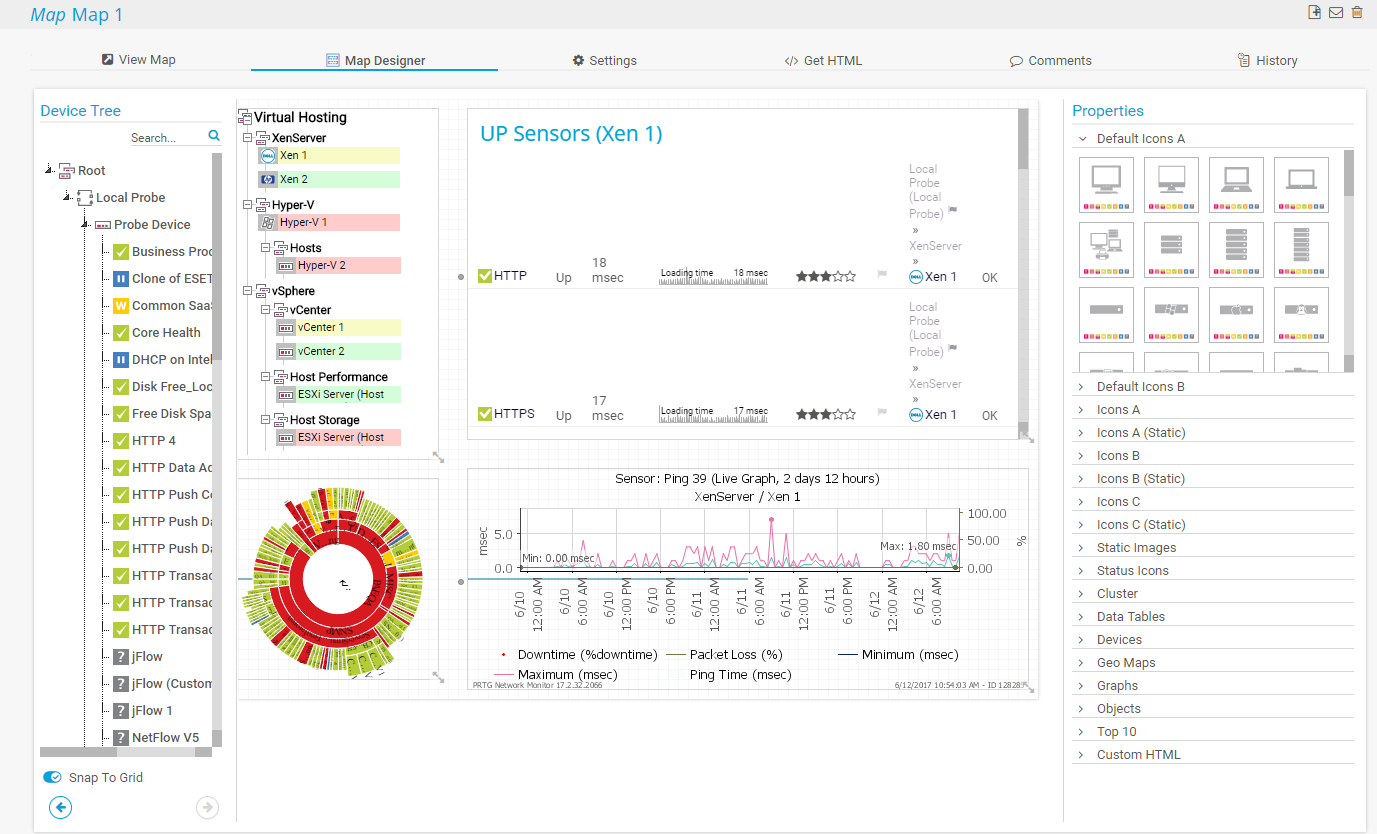
Las listas principales de PRTG proporcionan gráficos de protocolos y conexiones fáciles de leer, así como direcciones IP de dispositivos. Nuestro software también cuenta con un detector de red que le permite ver de inmediato qué está sucediendo de un vistazo. El sensor Analizador de paquetes de PRTG está configurado para mantener los volúmenes de datos al mínimo posible. Al mismo tiempo, proporciona información exhaustiva y la muestra en las listas de los “100 principales”.
Múltiples opciones de
captura de red
Junto con la detección de paquetes, PRTG utiliza otros protocolos de supervisión como SNMP, WMI para Windows y tecnologías Flow, incluyendo NetFlow, sFlow y jFlow . Por tanto, puede decidir, para cada caso concreto, cuál es el protocolo que funciona mejor para usted. Por ejemplo, puede decidir utilizar NetFlow para su hardware Cisco, o SNMP, que usa menos recursos, para obtener una descripción de alto nivel de su tráfico general. PRTG es el rastreador de red perfecto para todo su hardware.

Es más que un simple detector de red
PRTG es más que una simple herramienta de detección de redes: también es un software de supervisión integral. Le permite supervisar todos los parámetros vitales de su hardware, como la CPU y la memoria. En la edición de prueba de PRTG, todos los sensores están disponibles de forma gratuita. Esta edición también cuenta con una función de alarma e informes personalizables. PRTG es una herramienta de monitoreo de red todo en uno.

“Para nosotros, el monitor de red de PRTG es la herramienta más eficaz para el control de nuestra infraestructura de TI a largo plazo.”
Oliver Jahn, director de TI en la Universidad de Bonn
El estado de su aplicaciones de un vistazo
Configure PRTG en minutos y utilícelo en casi cualquier dispositivo móvil.

Análisis de paquetes: consejos e información
El análisis de paquetes,
de un vistazo
Muchos administradores desean realizar análisis de paquetes dirigidos o diagnósticos de la red. Gracias a ellos, a menudo ahondan más profundo que los procesos de detección de paquetes normales y corrientes.
Herramientas de captura de paquetes
Hay software y herramientas, como Wireshark, diseñados para analizar paquetes. Se pueden usar para mirar dentro de paquetes individuales y analizar su contenido. Sin embargo, necesitará saber exactamente qué paquetes desea analizar pues, de lo contrario, el volumen de los datos podría descontrolarse rápidamente.
Recomendaciones de análisis de paquetes
El software de análisis de paquetes, a veces, no funciona tan bien como se espera de él, y no siempre es adecuado para todas las situaciones. Por otro lado, PRTG es ideal tanto para pruebas como para detectar paquetes. También puede usar nuestra herramienta para excluir una serie de posibles fuentes de error de antemano y, luego, realizar un análisis de paquetes dirigido.
Los elementos esenciales sobre capturar el tráfico
Detector de tráfico de correo
Si el tráfico de correo se dispara de repente, hay que avisar a los responsables de TI y los administradores de sistemas de inmediato. Una sola dirección de correo electrónico puede causar picos en el tráfico. Por otro lado, tal vez hayan atacado su servidor de correo. Por lo tanto, el rastreo del tráfico es vital para la seguridad de su red.
Más acerca de la supervisión del correo electrónico.
Detección de transferencias de archivos
También querrá supervisar tus servidores FTP. En este aspecto, rastrear el tráfico significa asegurarse de que las cargas y descargas funcionen correctamente. Pero eso no es todo: también le permite detectar cortes o picos inusuales en los datos.
Más información sobre la supervisión de FTP.
PRTG le facilita el trabajo
Nuestro software de monitoreo le libera para que se pueda concentrar en otras tareas notificándole de inmediato sobre posibles problemas.

Ahorre esfuerzo
PRTG le ofrece una herramienta de monitoreo central para sus servidores y toda su red. Disfrute de una rápida visión general de toda su infraestructura a través de nuestro panel de control y aplicación.

Ahorre tiempo
Empezar a utilizar PRTG es muy sencillo. Instalar PRTG o venir de otra herramienta de monitoreo de red es muy fácil gracias a sus plantillas de dispositivos predefinidas y autoconfiguradas.

Ahorre dinero
El 80 % de nuestros clientes consigue ahorros sustanciales en costos con el monitoreo de la red. Su inversión en licencias probablemente se amortizará en unas semanas.
500.000 usuarios confían en nosotros y
los expertos nos reconocen como líderes del sector
los expertos nos reconocen como líderes del sector

“Fantástica solución de supervisión de redes e infraestructura, fácil de implementar pero aún más fácil de usar. Simplemente, el mejor sistema disponible.”

“El software es absolutamente perfecto, y su servicio de asistencia es superior. Cumple con todas las necesidades y requisitos. Se trata de una solución imprescindible para quien necesita cualquier tipo de supervisión.”

“La herramienta destaca en su papel principal de ser un servicio unificado de administración de infraestructura y supervisión de red.”

Consejo práctico: “Hola Stephan, ¿Tienes algún consejo para la detección de paquetes con PRTG?”
“El sensor detector de paquetes permite analizar el tráfico de la red, así como realizar una inspección de paquetes profunda. Puede ver, por ejemplo, si el tráfico del correo es alarmantemente alto, o si se está utilizando un sistema de intercambio de archivos P2P en la red de la empresa, lo que constituiría un riesgo para la seguridad de la red.”
Stephan Linke, departamento técnico de Paessler AG
¡Si nuestro mensaje le ha calado, debería probar PRTG!
¿Qué es un sensor en PRTG?
Un sensor es cada uno de los aspectos que se pueden monitorear en un dispositivo, como por ejemplo el tráfico de un puerto en un switch, la carga de la CPU de un servidor o el espacio libre de un disco duro. Se necesita una media de 5-10 sensores por dispositivo o un sensor para cada puerto de switch.

Ejemplo práctico # 1:
Detección de paquetes para la identificación inmediata de tendencias de uso
Un administrador de servidores en una empresa de tamaño medio, con alrededor de 5000 empleados, se percata de que el uso de ancho de banda ha incrementado drásticamente los últimos dos días. Gracias al sensor Analizador de paquetes de PRTG, puede determinar que una nueva aplicación en la nube está usando demasiado ancho de banda, lo que resulta en una carga adicional para la infraestructura de red.
Ejemplo práctico # 2:
Detección de paquetes para supervisar
el ancho de banda
Un administrador en una empresa con alrededor de 15 000 empleados desearía saber si puede recortar la cantidad de ancho de banda solicitada de su proveedor de servicios de banda ancha. Mediante el sensor de SNMP y el sensor Analizador de paquetes, determina que el consumo de ancho de banda total de la compañía es significativamente menor que la cantidad que adquirida. Por lo tanto, se pueden reducir los costes a largo plazo.

Ejemplo práctico # 3:
Detección de paquetes para mayor seguridad
Un administrador en una empresa de tecnología médica de tamaño mediano filtra el tráfico de acuerdo con las direcciones IP y los protocolos. Así, averigua que hay datos P2P circulando a través de una dirección IP determinada fuera del horario comercial. Por lo tanto, podría enfrentarse a un problema de seguridad de la red que, gracias a la supervisión de PRTG, puede corregir rápidamente.
Definición:
detector de paquetes,
rastreador de LAN
¿Qué es la detección de paquetes?
Los rastreadores le permiten verificar anomalías y supervisar el estado general de su hardware y software. Si se producen cambios, le notificarán de inmediato. Hay una amplia selección de herramientas y proveedores de detección de paquetes en el mercado. Durante los últimos 20 años, Paessler AG ha sido líder en el campo de la supervisión de redes y, en particular, en la detección de paquetes. PRTG, el producto estrella de la compañía, es una herramienta de análisis de red centralizada utilizada por más de 200.000 administradores en todo el mundo.
¿Qué es un rastreador de LAN?
Muchos administradores buscan rastreadores de LAN o Wifi. ¿Por qué? Porque los picos en el tráfico LAN pueden provocar fallos de funcionamiento y cortes: cosas que hacen que el rendimiento caiga en picado. Rastrear la LAN también es útil para hacerse una idea general de los recursos y los tipos de datos que generan más tráfico.
¿Qué es la supervisión de paquetes?
La captura y la supervisión son bastante similares. Capturar, detectar o rastrear paquetes es un proceso concreto y aislado que se hace para llegar a la raíz de los problemas. Por otro lado, la supervisión de paquetes es un proceso continuo que le notifica si se produce algún cambio.
Comparación de la supervisión del tráfico: WMI, SNMP, detección de paquetes, NetFlow
¿Cómo desea configurar su supervisión de ancho de banda? PRTG viene con múltiples opciones de supervisión, como WMI, SNMP, detección de paquetes y supervisión de NetFlow. Cada una de estas herramientas tiene sus propias ventajas y desventajas. Un resumen:
|
| WMI | SNMP | Captura de paquetes | Flow (IPFIX, NetFlow, sFlow, jFlow) |
|---|---|---|---|---|
| Instalación | Medio | Fácil | Fácil a complejo (dependiendo de las reglas de filtrado utilizadas) | Puede ser complejo (p. ej. se debe configurar el switch) |
| Puede filtrar el tráfico |
|
|
|
|
| Diferencia el uso de ancho de banda por protocolo o IP |
|
|
|
|
| PRTG puede mostrar listas de los mejores componentes (mejor transmisor, mejores conexiones, mejores protocolos, personalizado) |
|
|
|
|
| Filtra ancho de banda por IP |
|
|
|
|
| Filtra ancho de banda por dirección MAC |
|
|
|
|
| Filtra ancho de banda por puerto de red físico |
|
|
|
|
| Supervisa otros parámetros de red aparte del uso de ancho de banda |
|
|
|
|
| Carga de la CPU en la máquina que ejecuta PRTG | Medio | Bajo | Superior, depende de la cantidad de tráfico | Superior, depende de la cantidad de tráfico |
| Supervisa el exceso de ancho de banda | Pequeño | Pequeño | Ninguno (excepto cuando se utilizan los puertos de supervisión del switch) | Depende del tráfico |


Consejos del lector de nuestra base de conocimientos
¡Con PRTG, obtendrá libre acceso a una enorme variedad de características de asistencia! Generalmente, respondemos a sus preguntas en menos de 24 horas en días laborables. También ofrecemos un extenso manual de usuario y numerosos vídeos y tutoriales. Asimismo, puede encontrar las respuestas a muchas de sus preguntas en nuestra base de conocimientos. Aquí tiene dos consejos de lectores sobre la detección de paquetes, para que pueda adaptar PRTG de forma individual y dinámica para satisfacer sus necesidades específicas mediante una API:
Configuración del detector de paquetes
Tiene dos opciones para filtrar el tráfico de datos a través de la detección de paquetes.

Opción n.º 1:
Supervisar los datos de tráfico en un ordenador
Si desea vigilar solamente un equipo, como su servidor web, haga lo siguiente:
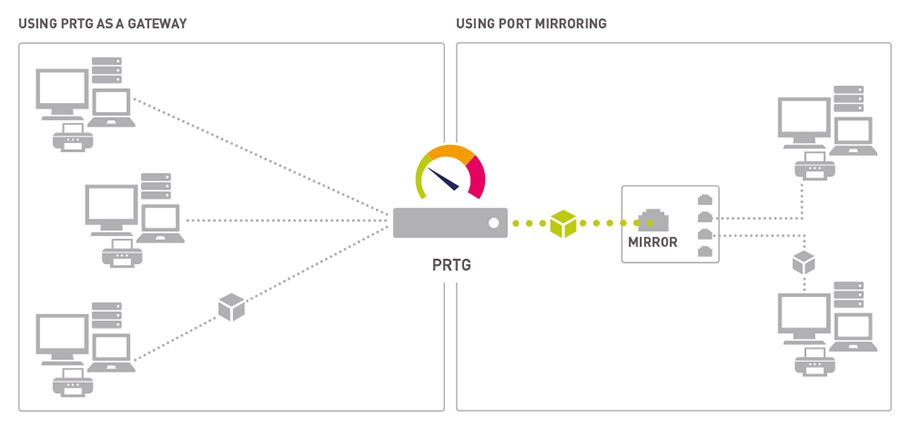
Instale una sonda remota en el equipo. Cree el sensor Analizador de paquetes en el dispositivo de sondeo y seleccione el tipo de tráfico que desea supervisar. Generalmente, puede elegir entre los protocolos de red más importantes.

Opción n.º 2:
Supervise todo su tráfico de datos
Si desea supervisar toda su infraestructura de TI, debe asegurarse de capturar todo su tráfico de datos. Configure un puerto de supervisión en un router o switch centrales. Utilice un cable de red para conectar el router o el switch a la tarjeta de red de un equipo que ejecute una sonda de PRTG. Ya se están enviando copias de todos los paquetes de datos a través de su sistema de sonda, y puede crear un detector de paquetes en el dispositivo de sonda correspondiente. Configure sus filtros de acuerdo con la información que desea supervisar.

PRTG: La multiherramienta para el administrador de sistemas
Adapte PRTG individualmente y dinámicamente a sus necesidades y apóyese en una sólida API:- HTTP API: Accese los datos de monitorización y manipule los objetos monitorizados utilizando solicitudes HTTP.
- Sensores personalizados: Cree sus propios sensores PRTG para una monitorización personalizada.
- Notificaciones personalizadas: Cree sus propias notificaciones y envíe desencadenantes de acciones a sistemas externos.
- Sensor REST personalizado: Monitorear casi todo lo que proporciona datos en formato XML o JSON
Todavía no le hemos convencido?

Más de 500.000 administradores
de sistemas adoran PRTG
Paessler PRTG se usa en empresas de todos los tipos y tamaños. A los administradores de sistemas les encanta PRTG por lo mucho que les facilita el trabajo.
Todavía no le hemos convencido?
Monitoree toda su
infraestructura de TI
Ancho de banda, servidores, entornos virtuales, sitios web, servicios de VoIP... PRTG vigila
toda su red.

Pruebe Paessler PRTG gratis
Todo el mundo tiene diferentes necesidades de monitoreo. Por eso se puede probar PRTG completamente gratis. Empiece ahora con su
prueba.
|
PRTG |
Network Monitoring Software - Versión 24.2.94.1400 (April 10th, 2024) |
|
Hosting |
Disponible como descarga para Windows y como solución hospedada PRTG Hosted Monitor |
Idiomas |
Inglés, alemán, español, francés, portugués, holandés, ruso, japonés y chino simplificado |
Precio |
Versión gratuita con 100 sensores. Ver precios de la versión comercial |
Unified monitoring |
Dispositivos de red, ancho de banda, servidores, aplicaciones, virtualizaciones, sistemas remotos, IoT y mucho más |
Vendedores y aplicaciones compatibles |


|